Bangladesh AI Landscape, 2023–2026
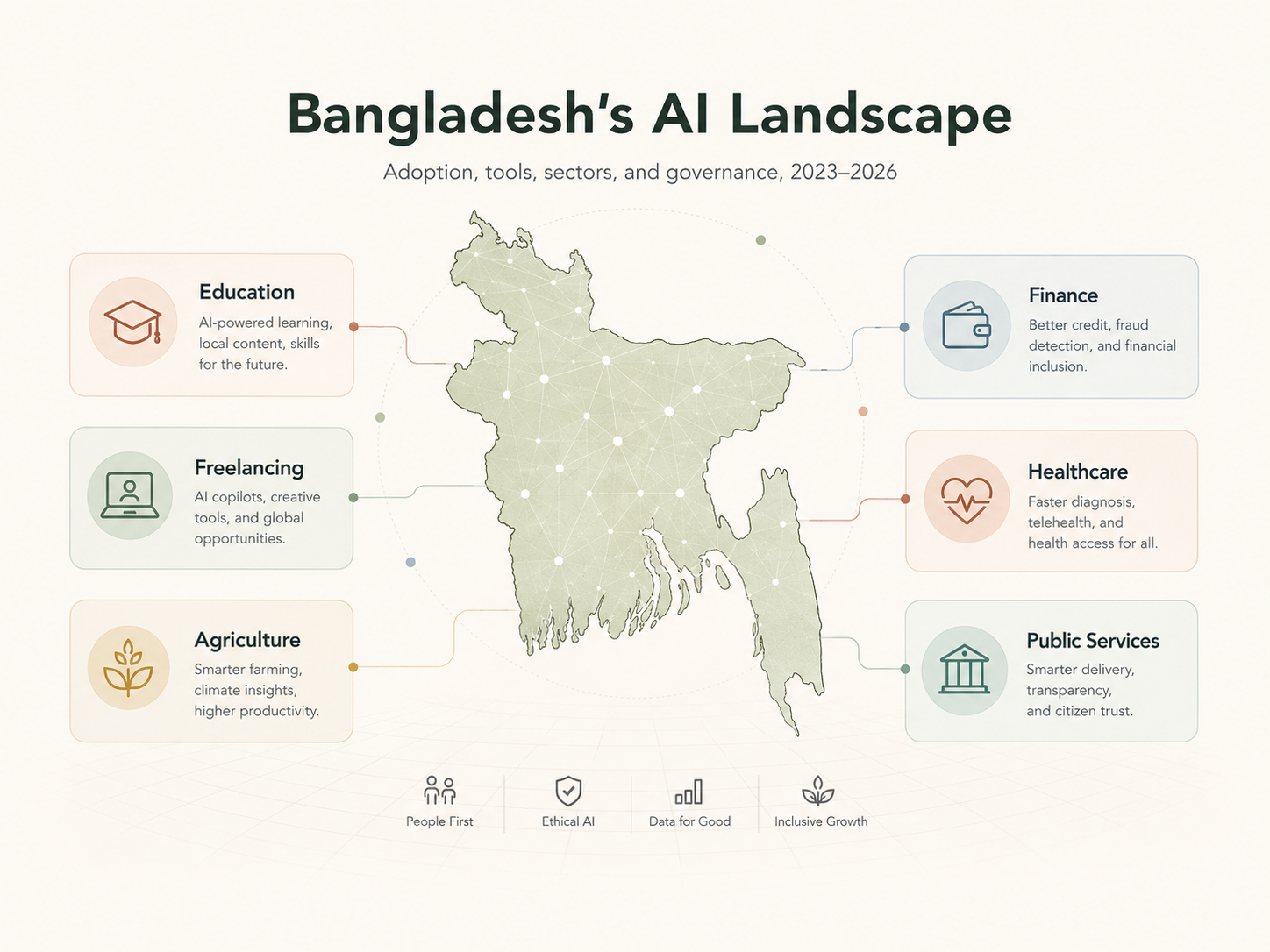
AI in Bangladesh is not waiting for the future. It is already inside classrooms, freelance work, banking apps, customer support, media production, and early digital health services. The change is not always dramatic from the outside. Most of it is happening through phones, browsers, chatbots, writing tools, design tools, translation apps, and business automation.
This research paper looks at how Bangladesh is using AI between 2023 and 2026: where adoption is growing fastest, which tools people use most, what benefits are visible, and where the risks are starting to show.
The short version
Bangladesh’s AI adoption is mobile-first, consumer-led, and uneven.
Students and freelancers are moving faster than many institutions. ChatGPT and Gemini are already common in study, writing, research, client work, and productivity. Banks, fintech companies, BPO firms, newsrooms, and manufacturers are also adopting AI, but mostly in specific workflows rather than full organizational transformation.
The main finding is simple: Bangladesh is already using AI heavily, but the country still needs better governance, stronger Bangla-language AI, workforce training, and safer rules for high-risk sectors like finance, healthcare, education, and public services.
What the paper studied
The paper focuses on five questions:
- Where is AI being used in Bangladesh?
- Which AI tools are most visible?
- Which sectors are adopting AI fastest?
- How is AI affecting mental health and work anxiety?
- What should Bangladesh do next to make AI safer and more useful?
The analysis is based on recent reports, platform-share data, sector studies, policy documents, and documented AI deployments from 2023 to 2026. Since Bangladesh does not yet have a single official AI-use census, the sector numbers are best read as researcher-synthesized estimates. They combine survey evidence, visible deployment examples, documented sector activity, and the scale of known use cases.
Key numbers
AI chatbot market share in Bangladesh mobile traffic, April 2026:
- ChatGPT 57.93%
- Google Gemini 38.32%
- Perplexity 2.93%
- Claude 0.45%
- Microsoft Copilot 0.38%
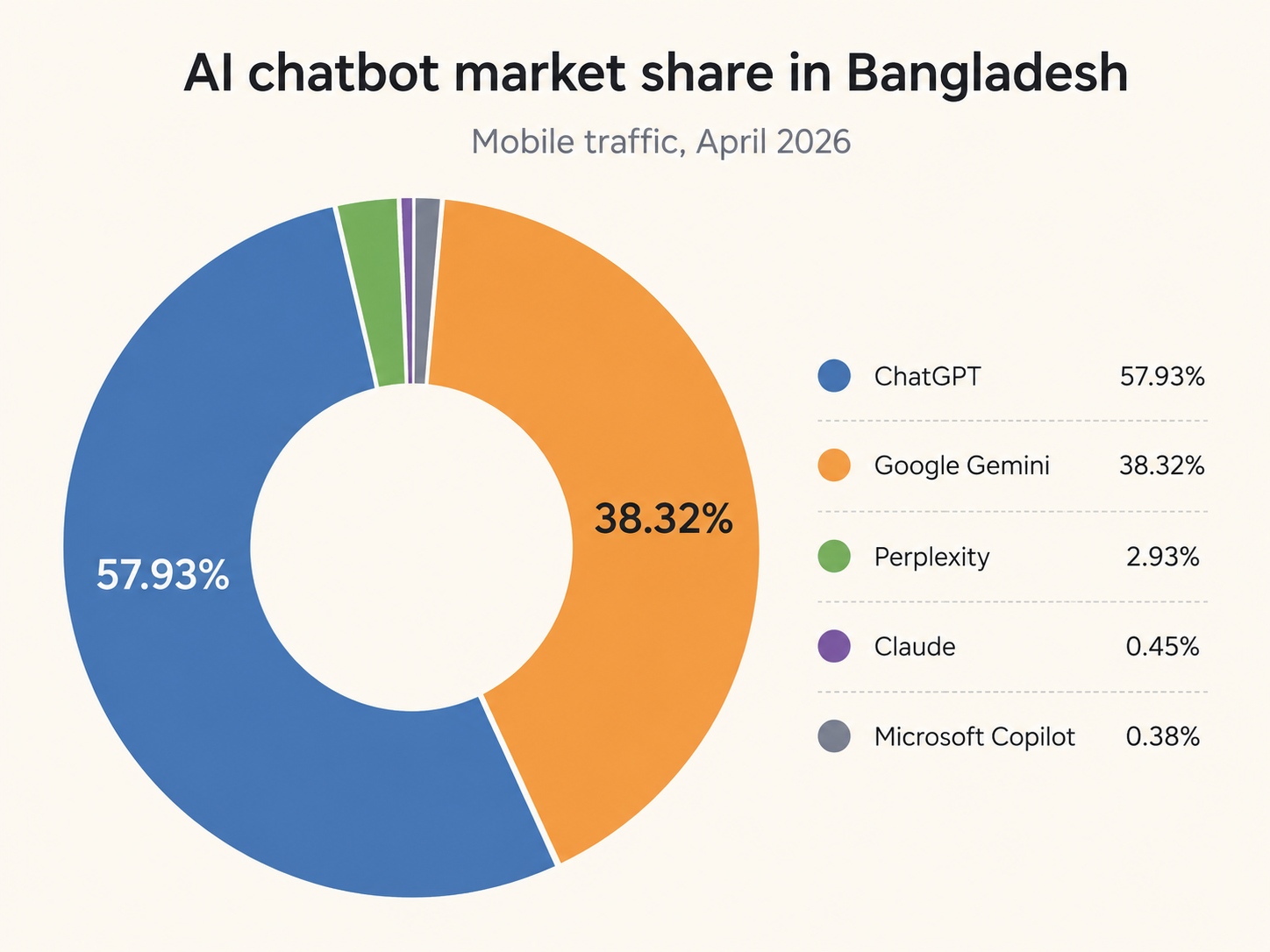
ChatGPT leads clearly, but Gemini’s share is unusually strong. That likely reflects Bangladesh’s Android-heavy mobile ecosystem and Google’s deep presence in search, translation, email, and productivity tools.
Where AI use is strongest
The paper estimates Bangladesh’s documented AI activity by sector as follows:
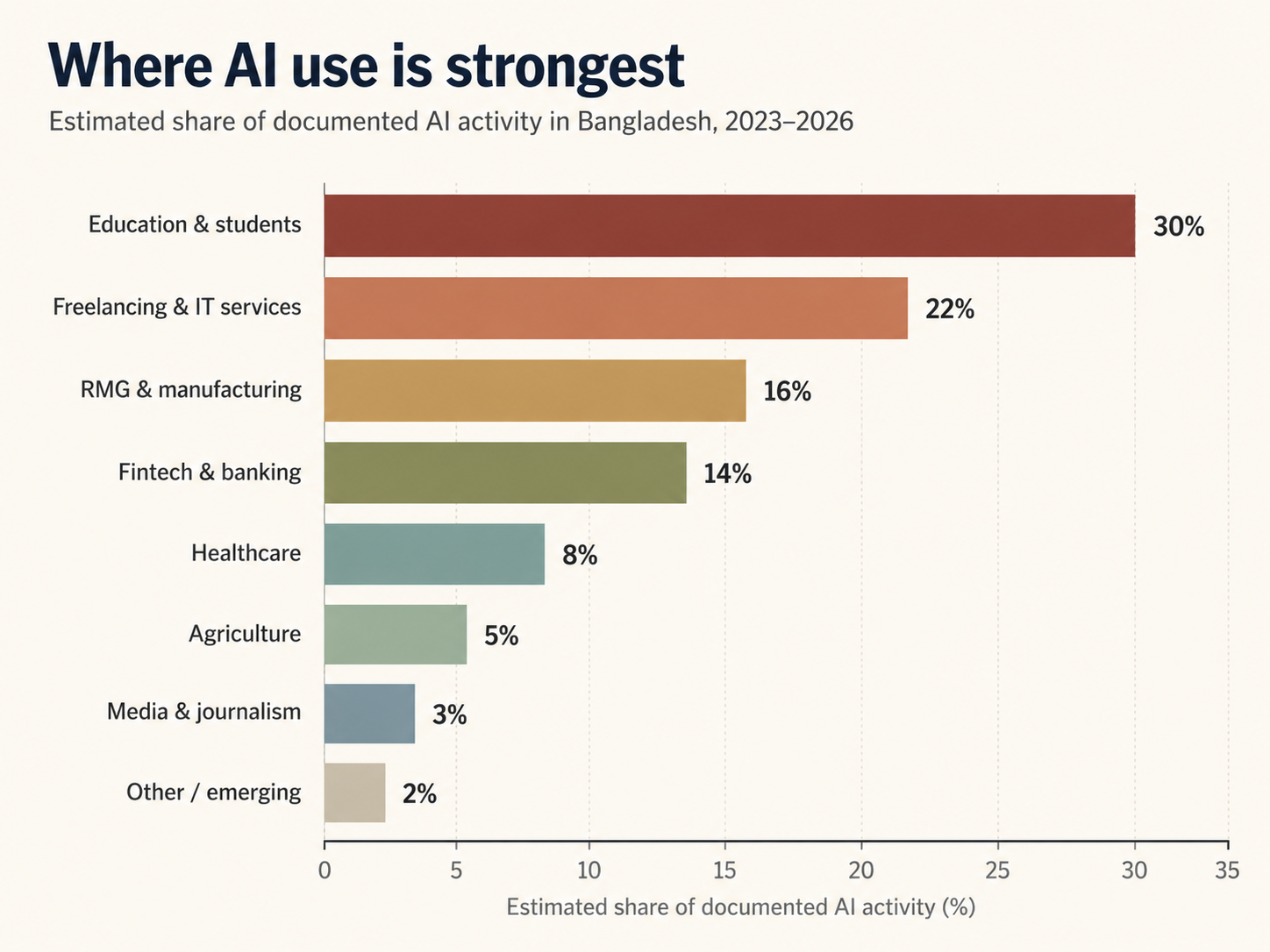
Education is the largest visible category because AI is being used every day for assignments, explanations, writing, translation, coding help, and exam preparation. Freelancing comes next because AI directly improves output speed, English communication, design work, and software support.
Education: the biggest visible shift
AI has quickly become part of student life. Students use it to explain difficult topics, summarize readings, improve English, generate ideas, write code, and prepare assignments. Teachers are also beginning to use AI for lesson plans, question creation, and learning materials.
The benefit is access: A student can get instant help even without a tutor. The risk is dependency: If AI becomes a shortcut instead of a learning aid, it can weaken writing, reasoning, and academic honesty.
This is why schools and universities need clear rules. Banning AI completely will not work. But using AI without disclosure, verification, or learning goals will also create problems.
Freelancing: productivity boost, but not for everyone
Bangladesh’s freelance and outsourcing workers are some of the fastest AI adopters. AI helps them write proposals, polish English, design faster, generate content, debug code, analyze data, and handle more clients.
For skilled freelancers, AI is a multiplier. It helps one person produce work that previously required a small team. But for workers doing basic writing, simple design, low-level SEO, translation, or repetitive coding, AI can reduce prices and increase competition.
The lesson is clear: the future belongs to workers who can combine AI tools with judgment, taste, domain knowledge, and client understanding.
Business, banking, and manufacturing
AI is also becoming practical inside companies. Banks and fintech firms are using AI for fraud detection, KYC, customer service, risk scoring, onboarding, and complaint analysis. In manufacturing and RMG, AI is being used for defect detection, demand forecasting, production planning, and supply-chain decisions.
These uses matter because they are not just experimental. They can reduce repetitive work, improve accuracy, and save time. But they also bring risks: biased credit decisions, wrong fraud flags, worker monitoring, opaque automation, and job anxiety.
High-risk AI should always have human review, audit trails, appeal systems, and clear accountability.
Mental health: helpful, but risky
AI has a two-sided mental-health impact in Bangladesh.
On the positive side: AI can help people ask private questions about stress, anxiety, relationships, reproductive health, and emotional wellbeing. This matters because many people still avoid human support due to stigma, cost, or lack of access.
On the negative side: AI can create pressure. Students may feel they must use AI to keep up. Workers may fear replacement. Young people may become emotionally dependent on chatbots. Algorithmic social media can also increase comparison, anxiety, and sleep problems.
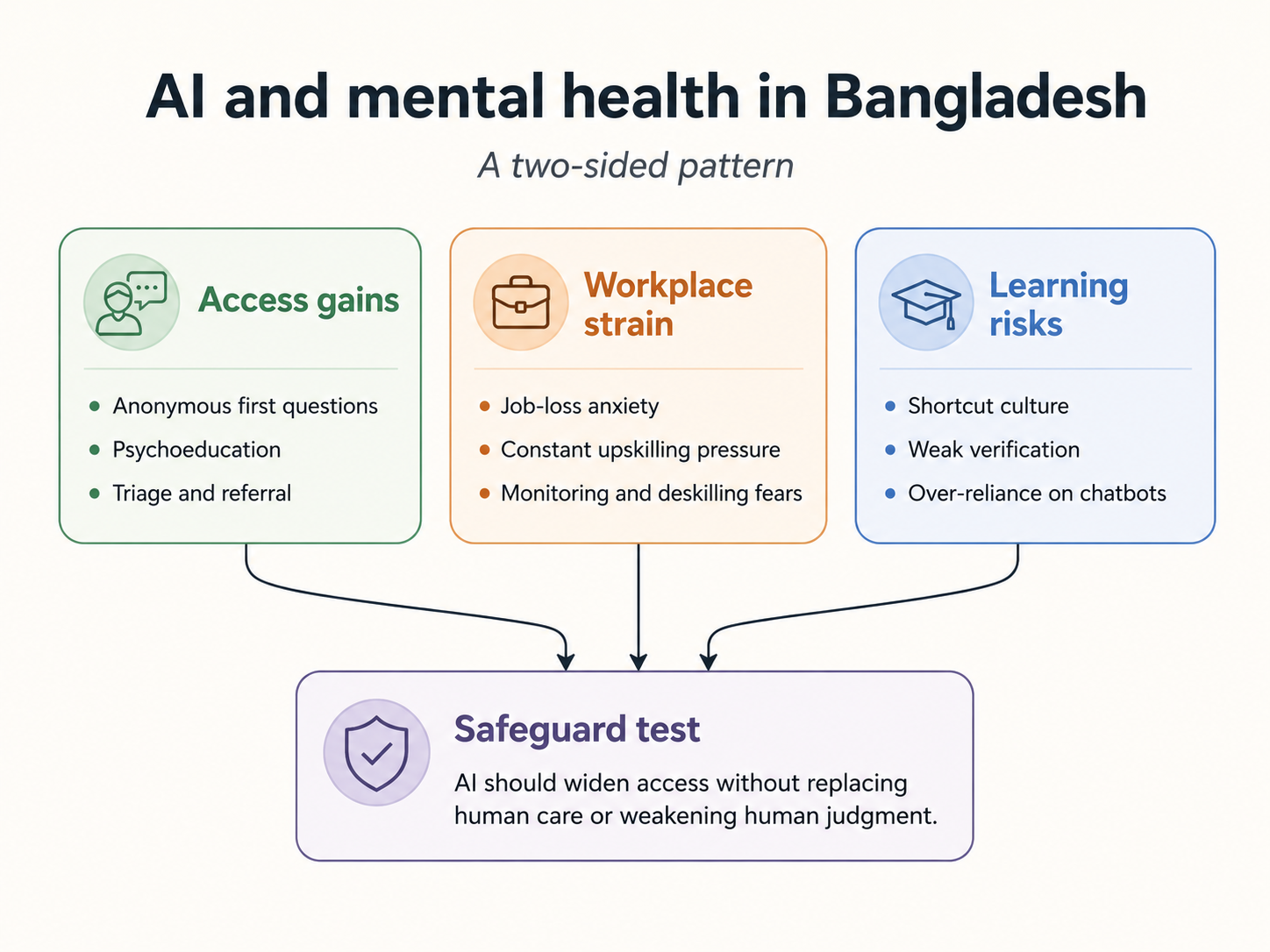
The paper’s position is careful: AI can support mental-health access, but general-purpose chatbots should not be treated as therapists. AI systems for vulnerable users need privacy protection, crisis handoff, human referral, and clinical oversight.
The governance point
Bangladesh does not need to stop AI adoption. It needs to guide it.
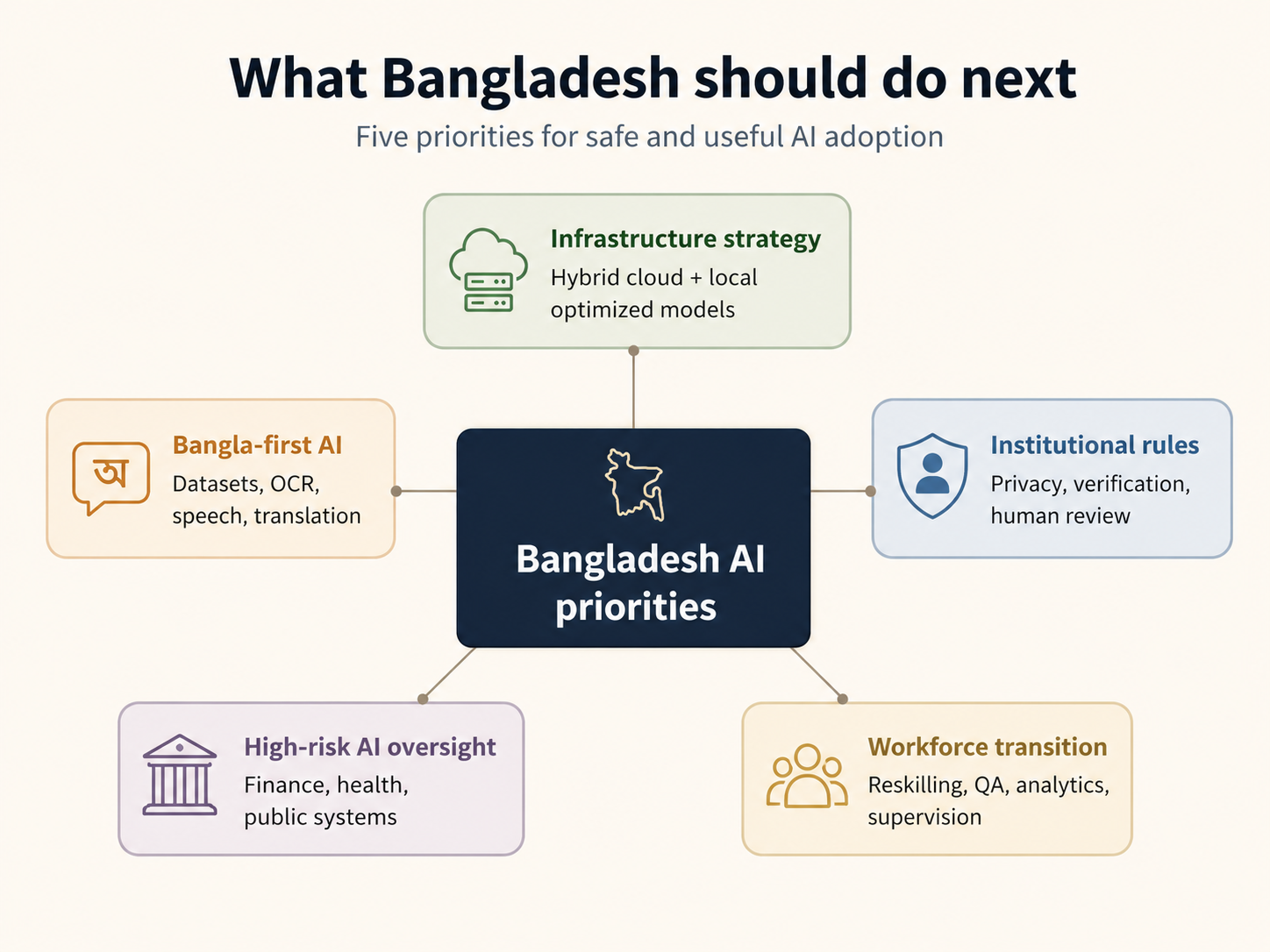
The paper recommends five priorities:
1. Build Bangla-first AI
AI tools must work well in Bangla, not only English. Otherwise, the biggest benefits will go mainly to urban, English-comfortable users.
2. Train institutions
Schools, banks, newsrooms, hospitals, BPO firms, and public offices need rules for privacy, verification, disclosure, and human review.
3. Treat high-risk AI differently
A chatbot helping with brainstorming is low risk. AI used for credit, healthcare, surveillance, grading, or public penalties is high risk and needs stricter oversight.
4. Prepare the workforce
AI will change tasks before it replaces whole jobs. Bangladesh needs training in AI supervision, quality control, automation design, analytics, and domain-specific AI use.
5. Reduce blind dependency on foreign platforms
Most AI use depends on foreign APIs and cloud systems. Bangladesh needs local data capacity, affordable compute strategy, model optimization, and public-interest AI infrastructure.
The technical issue people often miss
AI policy is not only about ethics. It is also about infrastructure.
Cloud AI is easy to use, but it creates recurring costs, vendor lock-in, privacy concerns, and API dependency. Local AI gives more control, but it requires GPUs, memory, optimization, electricity, engineering skill, and maintenance.
For Bangladesh, the realistic path is hybrid: use cloud models where needed, but build smaller optimized Bangla-capable systems for education, public services, rural tools, healthcare support, and low-bandwidth environments.
"The question is not only 'Which AI is smartest?' It is also 'Which AI can Bangladesh run safely, affordably, and at scale?'"
Final takeaway
Bangladesh is already inside the AI transition. The biggest opportunity is access: better learning support, stronger freelancers, smarter finance, faster services, and more inclusive digital tools.
The biggest risk is unmanaged adoption: dependency, misinformation, privacy loss, job pressure, weak academic standards, and unequal access.
AI can become a national advantage for Bangladesh, but only if it is localized, governed, and connected to real human needs.